

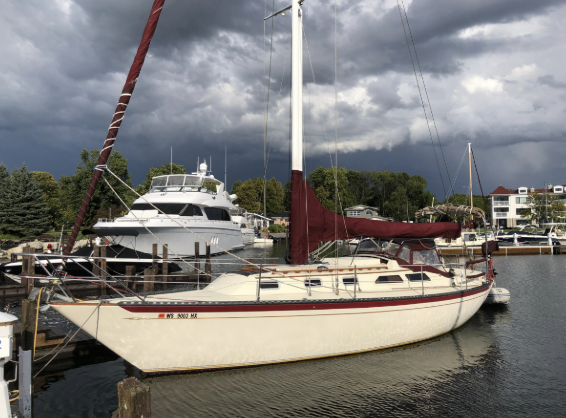
Islander 36 vs. Morgan 382
By Bob Perry
UK designer Alan Gurney had just had tremendous success with the WINDWARD PASSAGE (WP) design for a Southern Californian offshore racer Robert Johnson. WP was designed to be the ultimate maxi ocean racer for off-the-wind races. It was a light boat, with a dinghy-like hull form well suited for planing speeds downwind. WP was dominant on the racing circuit and remains a contender today over 50 years later. Buster obviously took notice of WP’s success and commissioned Alan Gurney to design a new 36’er for Islander.
The early ’70s were when the IOR International Offshore Rule was just beginning to dominate large boat racing and replace the old CCA rule for handicaps. But in the hull form of the I-36, I see no IOR influence. I see a hull of very moderate proportions that perhaps bridged the gap between CCA and IOR types. That was a very good move for marketing as the relatively complex IOR had a lot of cruiser/ racers and racer/cruisers very nervous.
The I-36 has a D/L of 266, which is about the same as a Valiant 40. It’s not a light boat. The ballast to displacement ratio is a conservative 40.5%. I think we can all agree, nobody likes a tender boat and a high B/D ratio helps provide stability. What Gurney gave Islander was a good, all-around performer with excellent stability and good manners with a skeg hung rudder, a moderate aspect ratio fin keel, and enough overhangs fore and aft to give the boat an elegant look. Standard draft is 6’ with an option for a shoal 4’9” version.
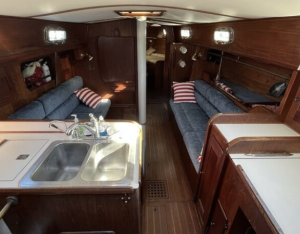
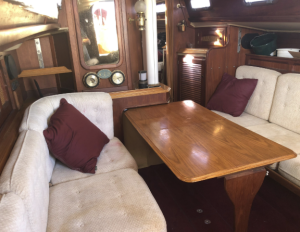
The I-36 had “good bones” but bones don’t make for exciting marketing. This is where Buster got creative. Buster hired SoCal interior designer Joe Artese to design the interior of the new model. Sailboat layouts had become very predictable to the point of being “stale”. You’ve seen one you’ve seen them all kind of thing. Artese brought fresh eyes to the problem. Take yourself back to 1971 and step aboard the I-36. Go below.
Now this was different. First off, the spaces were wide open and inviting. The standard centerline drop-leaf dining table was gone. Not really “gone” but it was cleverly hidden below a narrow shelf to port where it could be hinged out to provide a dining room for four. This was key to the appeal of this interior and would be echoed in future Islander models that I designed.The rest of the layout was pretty standard in terms of geometry but Artese spiced the finishing details up with a style I call “California Rococo”, a far cry from Maine bland. Locker doors had cane fronts which added an interesting aesthetic compared to a dark, all teak or mahogany veneer look. In short, this interior was unique in style and substance and it sold like crazy.
Islander built 770 Islander 36s and the I-36 is alive and well today with very active class racing on San Francisco Bay. In the early days of my own design office, I was struggling to make ends meet so I slept on the floor of my office for a while. I kept my clothes in a file cabinet. One drawer was labelled “undies”. But a couple I knew took pity on me and offered me their I-36 to stay on for a few months. I was and am still grateful. But living on board the I-36 I became aware of one shortcoming of the layout. There is a paucity of lockers including a decent wet locker. But you don’t complain when the rent is free.





This Post Has One Comment
Great comparison of two classic designs! The article mentions the Islander 36’s excellent stability, which got me thinking about managing another kind of stability—blood sugar levels—on long voyages. For those cruising with type 2 diabetes, maintaining that balance is crucial. I recall reading about a medication like Gliquidone, which is often used for this purpose. Does anyone have practical experience with managing diabetes while on extended passages, and what are your thoughts on the availability of such medications in different ports? For reference, I found some basic information on it here: https://pillintrip.com/medicine/gliquidone, but firsthand cruising advice would be invaluable.