A Wannabe Bluewater Cruisers Progression
By David Levesque, Editor of Latitudes & Attitudes
In our Sept/Oct 2025 issue, I interviewed Melanie & Erik Kyle, owners and publishers of Latitudes & Attitudes magazine, as they popped the cork on their dream of bluewater cruising. Realizing they have much to learn, but with determined dreams, they set about joining up with the Bluewater Cruising Group, which has the simple mission to provide ordinary people with the tools and roadmap to live extraordinary lives of freedom and adventure.

As a publication, our mission is to globally inspire people into the cruising lifestyle. And in doing so, we endorse and support the many sailing and offshore cruising schools and classes found just about anywhere in the world.
Bluewater Cruising is one of them, and they have a fundamental model of bringing all the education, knowledge, and know-how required to be a successful cruiser into a one-stop shop. As a bonus, anyone partnering up with them becomes part of a growing family of like-minded cruisers and educators, providing ongoing real-time resources for the entire journey.
We know the cruising lifestyle often begins with a simple dream, and far too often those dreams can run smack into the wall of reality. Simply put, we just don’t know what we don’t know. With Bluewater Cruising, having the opportunity to interact with actual bluewater cruisers who have been there and done that offers immense opportunity to pick their brains. The old adage, “If it’s gonna happen, it’s gonna happen out there” is insanely accurate. Having the opportunity to be as prepared as humanly possible for what might happen out there cannot possibly be overstated.
Each year, Bluewater Cruising hosts what they call a Summit. Essentially, it’s a five-day intensive into the cruising lifestyle so you can see what life aboard really looks like, directly from the people living it, or who have lived it. You have the opportunity to talk with cruisers and board the actual boats from members who are already in the lifestyle. If you have a particular boat in mind you think fits your cruising lifestyle needs, it will be there. Attending the Summit allows you to pick the brains of the people actually living it and doing this wonderful lifestyle.
Bluewater Cruising refers to this intensive as the “Summit” simply because they view preparing for the cruising lifestyle as climbing a mountain. And it is their mission to help you reach the summit.

It’s no secret, untying the dock lines and going cruising requires a plan. Even the most accomplished sailor and boater finds out quickly that not everything they thought of goes according to that plan.
This lifestyle can humble you very quickly.
You might be the most handy individual. A sure-fire, badass bona fide Mr. Fix-it. Now take 30-knot winds, 8 to 10’ seas, and a sudden broken seacock. Or perhaps you’re 1500 miles offshore, and the watermaker goes. Or how about one of the most daunting concerns: the financial part. Many people ask, just how much it costs to go cruising. Obviously, it depends on how long you plan to be out there, and the Bluewater Cruising gang will suggest giving it at least a year. This is, you’d be surprised how many people give up before that 12 months is complete.
At the end of the day, there is no such thing as too much planning and preparation for bluewater cruising. This is where their Summit comes in. Recently, I sat down with Chris Biasutti, one of the founders and owners of Bluewater Cruising, for a discussion on the origins of their group and the Summit itself. This is Part One of that interview.

David: Hey Chris, pleasure to have the chance to talk with you about Bluewater Cruising. Why don’t we start with a little overview of your mission and the Summit event?
Chris: Thanks, David; pleasure as well to catch up. Our mission, and the reason we started everything that we do, is that there’s very little in the boating space that is dedicated to people who want to go bluewater cruising, as far as service providers, like insurance brokers, mechanics, etc. People that want to go bluewater cruising are the 1% of people that want to own boats. And so our thing is: let’s serve the 1%.
We don’t want to serve the guy that buys a boat and only keeps it in a marina. That’s fine for him to do, but we want to go serve the client that buys the boat and goes on a mission. And so when it comes to the Summit event, it’s not a boat show. There are 2 different aspects to it. The first aspect is somebody who wants to go bluewater cruising, but they don’t really know what it’s about. They have this dream; maybe they’ve watched YouTube, they’ve read some books, or whatever it is. The event is designed as a portal for them, as a way for them to kind of step through into the world of what it’s like to cruise. And the way we facilitate that is we have actual cruisers come, with their boats.
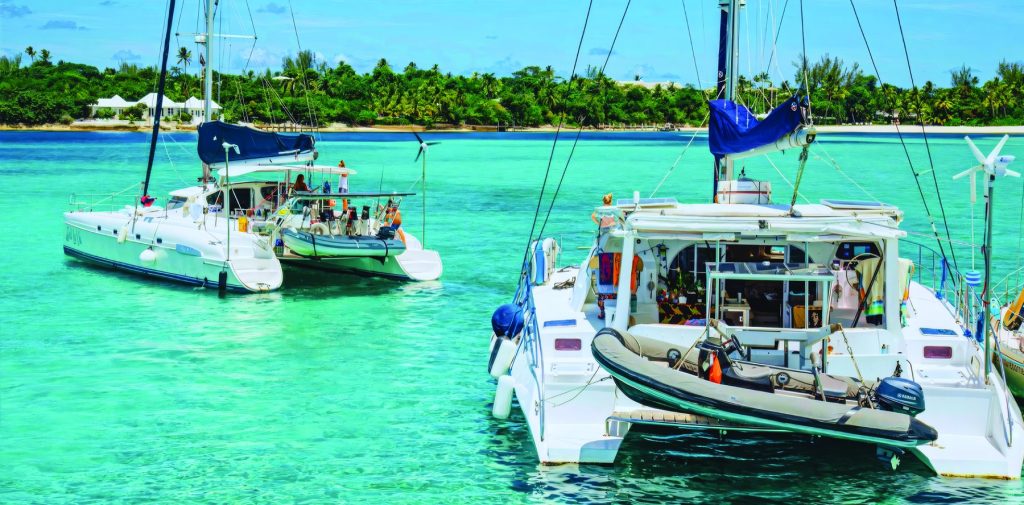
In Hawks Cay, we had about 20 boats that were there. It was literally the families that were cruising there hanging out. In 2027 we’ll have close to 30 there of all different types: trawlers, monohulls, catamarans.

The second type of person is the person who knows they want to go cruising. They’re already saying I don’t need to decide anymore. I know I want to go. And their next big question is What’s the right boat for me? And our philosophy is the best possible thing you can do is go get on other people’s cruising boats. See how they’re laid out, talk to the owners about what they like, what they don’t like.
David: Ok, so essentially you start at the beginning with the boat. People have a dream; they know what they want to do, but it starts with the boat itself. What works best for them.
Chris: Exactly. And I mean, we can’t cover everything, but we go back to the beginning with everybody. For people that are thinking about doing this lifestyle, the analogy I like to use is that it’s like climbing a mountain. And depending on how you want to cruise, the size of the mountain changes. Let’s say somebody wants to go across the Pacific or even just go sail the Caribbean for a year. And they’re like, what do I need to do to do that? I need to buy a boat. I tell them buying the boat is not the summit.
For example, we’ll use Mount Everest. Buying the boat is actually Everest Base Camp. You don’t just wake up one day and be like, I’m gonna fly to Nepal, pack my suitcase with some toiletries and a change of clothes, and show up to Everest Base Camp and hope that I’m going to be able to climb the mountain successfully.
You spend a fairly long amount of time planning, equipping your team, making sure you have the right gear and supplies. And then you go to base camp with that team, and then Sherpas help you climb the mountain. So the way I draw the analogy is, what the summit is in mountain climbing for cruising is getting to the end of the first year.
There are some statistics around this: the average amount of time people cruise for is about 2 years. People get in, and they get out about 2 years later. And nobody really knows the reason for that. There are a few things. Like health. There are a lot of older people who do this, so they have health issues, and they get out. But I think the main thing is people don’t plan and prepare properly. They get in, and the lifestyle hits them in the face like a sledgehammer because things happen they didn’t expect. And so now we’re back to the mountain climbing thing.
Our job is to get you from where you are to base camp and then to help you climb the mountain. And then climbing the mountain is the first year.
The other thing we see is when they hit the wall. And the size of the wall changes and the speed at which they hit it changes, but every single person hits one. So having some sort of support in that first year, pre-set up, knowing the plan, is just like climbing a mountain. If you have a good team in base camp, no matter the obstacles you come across, you’re going to get through it and keep going. But if you’re on your own with no gear and shorts and your t-shirt, you’re gonna be back in base camp.

David: Define hitting a mountain. Define what that is in the cruising lifestyle.
Chris: So I’d say the size of the wall is usually directly correlated to the amount of planning and preparing you do. However, there are always unforeseen things. One that we hear all the time is people buy boats, stuff happens, and they try to sell it.
One guy came to one of our early workshops, felt it was cool, but thought he could do it himself. He then called me 6 months later from Southeast Asia and asked if we could help sell his boat. So naturally I asked what happened. And he said, I bought a boat in Thailand. I thought I knew what I was doing. I got on the boat. In the first 6 months, I made every single mistake that you could make. Sailed in the wrong conditions; stuff broke that I didn’t know how to fix. Sailed into the wrong anchorages, ended up in sketchy situations that I didn’t want to be in. I made every single mistake. I’ve learned from those mistakes. The problem is my wife has now left the boat with my kids, taken them back to San Diego, and basically is going to divorce me if I don’t sell the boat. So I’ve got to sell the boat.
He goes on to tell me the shitty thing is that in these last 6 months making these mistakes, I now have a pretty good idea of what I didn’t know that I didn’t know. And I know how to fix all this stuff, but it’s too late. I’ve burned them out, and the dream’s done. And then he says, you need to operate at the level of your competence, not your confidence.
There are different demographics of people, but there’s definitely a demographic of people that want to go cruising, including myself. It attracts fairly Type A people that are like, I want to go and do this. And there’s a danger in operating at the level of your confidence, not your competence, which runs you into these situations that you kind of underestimate.
I’ll give you another example. There’s a guy who joined us, and he bought a boat, a newer catamaran; it was like 5 years old, 1,200 hours on the engine. 3 months into cruising, the engine blew up on him. An internal component in the engine just gave way. At the end of the day, it was a manufacturing defect in the engine. And he’s 3 months into cruising on a fairly new boat. That’s a wall.
He thought he was going to be cruising all the way up the East Coast and then into the Bahamas. He takes the boat to somewhere in Charleston to get it repaired. And they said $35,000 and we can fix this for you. And he’s like, I just spent half a million dollars on a boat! And he’s not a mechanic. Hence the wall.
We have a community of members on the East Coast, and people were stopping in to help him. Long story short, he fixed that engine for around $5,000 in 3 weeks, with no prior maintenance knowledge, with our help and the help of the community members stopping in. He wasn’t alone. He had all these people that were willing to help.

David: Certainly makes a lot of sense. And I think that’s a really positive thing that you focus on. Not the beautiful rainbow of the dream, but all the other stuff that goes along with it.
Chris: 100%. Cruising is a series of highs and lows. We tell people, you’re making a decision to go embrace a lifestyle that is a series of high highs and low lows, and you can’t have the high highs without the low lows. There’s something about going cruising, where you have to have these things happen to humble you.
I’d also say cruising amplifies anything in your life. Whatever you have in your life right now, cruising will amplify it. If you have a good relationship, cruising amplifies that. If you have a relationship that’s got a little tension in it, that’s going to be amplified when you get onto the boat. We actually have a whole module on relationships and what happens to your relationship when you go cruising.
David: A lot is said with cruisers about the financial part. Let’s touch on that and how you offer assistance.
Chris: The number one question on average is, what does it cost? How can I afford it? We try to get the client to what we call financial clarity. We help them come up with a net number. And I think the confusion around finances often comes from people thinking too big, really. A lot of people are like, I want to go buy a boat and retire or sail off into the sunset, or I want to go sail around the world. All these are massive concepts that are very difficult to put a plan around. And so we say start with a 12-month mission. And that’s where this whole realities and practicalities thing comes in, because what would buying a boat and going somewhere and doing something on that boat for 12 months look like?
Whatever that year is, we get them to map it out in as much detail as possible. And then with that detail, it’s very easy to put a financial plan around it because we have all the numbers, and we have people that are doing it right now. So if they buy a boat and go cruising for a year, and at the end of that year they sell the boat, what’s the net number that it costs them to actually go do this?
Typically that number varies from as low as $30,000 to $40,000, to as high as $150,000 depending on what they want to buy, and the quality of life that they want to live while they’re cruising. So what we find is that when people actually go through the exercise of figuring that out, the decision becomes easy: the financial decision, and do they want to go spend the money on that? Do they have the money to go do that? And if they do, do they want to go and spend it to have that experience?
For more information on Bluewater Cruising and their upcoming Summit from Jan. 6-10 2027, visit their website at bluewatercruising.com
Look for Part Two of this interview in the Jan/Feb issue.
Want more cruising stories and interviews like this delivered to you? Subscribe to Latitudes & Attitudes.