Wet, Winchless, and Climate-Conscious
A Glimpse Aboard a Trans-Atlantic Sail Cargo Vessel Crossing
By Annie Means
“Oh, crap.”
Never entirely comforting words to hear from your captain, but utterly appropriate. I heard it too, after all—the cascade of rumbling and ripping, rising gradually in pitch in the span of seconds—the sound of thousands of pounds of sailcloth shredding.
Unlike my captain, however, I had yet to actually see it—or rather, them. I watched his head turn further to the right, eyes wide.
“Oh, no.”
And there was the other it.
During an unfavorable jibe in a gale in the English Channel, we simultaneously tore not just our foresail but also our mainsail—one split in half, the other reduced to two-thirds.
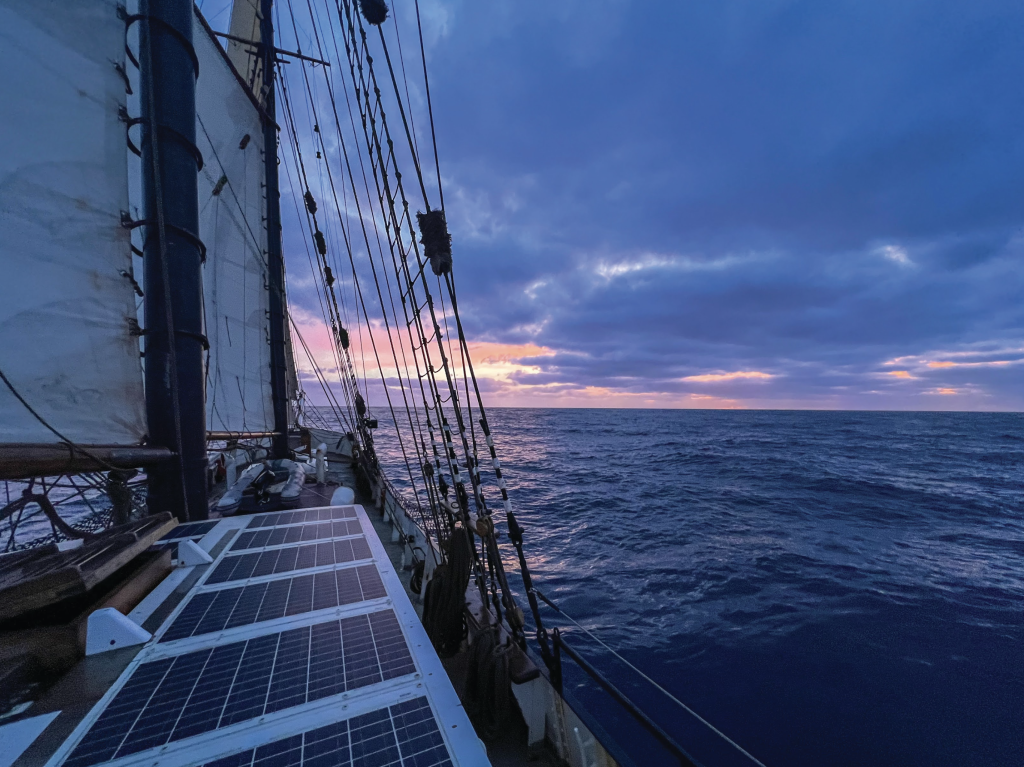
As the sun began to set, our situation was looking less than ideal as we jostled in the choppy waters between France and England. This was especially concerning, given that our vessel—a 105-year-old gaff-rigged schooner—carried no extra sails. Our engine, which was only to be used in emergencies as this was a sail cargo vessel, had a top speed of no more than 5 knots on a flat sea with no current.
And here we were at 8 p.m., caught in particularly large seas at a geographical chokepoint, where currents had been recorded at speeds of up to 13 knots. Our main boom thrust in and out of the water, while hundreds of pounds of newly wet and ruined sail dragged off our starboard side.
A calming way to end my watch.
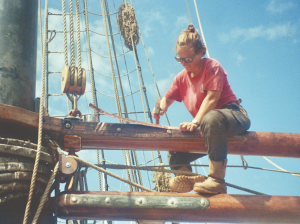
Yet, as the saying goes, many hands make light work. Within minutes, rubber boots—and the newly awakened shift that wore them—clambered across the lurching deck. In an instant, our bosun, an emergency nurse and Ph.D. from France (a woman accustomed to high-stress situations) strapped into a harness and began scaling the main mast. The damage was worse than initially thought; several mast hoops also needed repair.
The captain and first mate began issuing orders, with one taking the wheel to corral the ship amid the bounding rollercoaster of waves. The rest of us moved quickly, each task aligning with the next. Shortly, our many hands began to work as one.
On a vessel of this size and of this age, there were no automatic winches, no buttons to push to hydraulically reel in the boom. Instead, everything was as it was designed 100 years ago—the boat a living, breathing artifact that required living, breathing bodies to sweat and exert themselves to make the hulking beast do as it was told.
Click to read the rest of this story and see more great photos.