

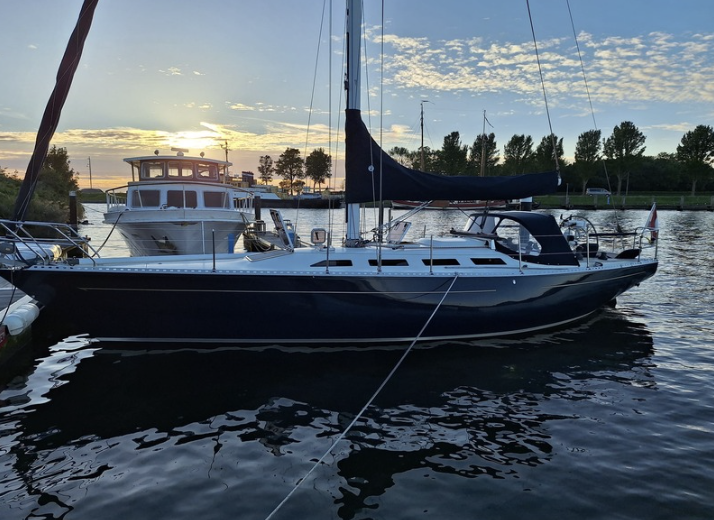
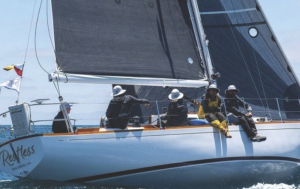
Cal 40 vs. Ranger 37
In this issue, we’ll compare two production boats that were designed to two different handicap rules, neither of which left their mark in the racing world, but have also truly stood the test of time.
Cal 40
“Iconic” is an overused word these days, and the more it is used, the more the true meaning of the word is diluted. But I feel very justified in saying that the Bill Lapworth-designed Cal-40 is iconic. It would be hard to find another production boat that has had such an impact as the Cal-40.
Designed in 1964 and built by Jensen Marine, builder of the Cal series, the concept for the Cal-40 was the idea of George Griffith, a well-known Los Angeles-area yachtsman. Griffith collaborated with Jensen and Lapworth, and Lapworth – who had begun championing the idea of lighter displacement boats since the late 1940s – was quite amenable to the design collaboration. Jensen was more reticent until Griffith agreed to back the production of the first 10 boats. The result was the Cal-40, designed to the Cruising Club of America (CCA) rule, but intended to be a boat that would be at its best in downwind conditions, and well suited to the Transpac race from Los Angeles to Hawaii.
The Cal-40 displaced 15,000 pounds, for a Displacement to Length (D/L) ratio of 240. In 1964, that was considered a very light boat; today, considering that the Valiant-40 has about the same D/L ratio, this is significant. The beam is 11 feet, for a Beam to Length (B/L) ratio of 3.64, which by today’s standards would be considered narrow. Interestingly, looking at the hull lines drawing, one thing that stands out to me is that BWL (Beam at Waterline) and B-Max (maximum beam) are almost the same, indicating that the shape has good initial stability.
Draft is 5.85 feet, with a medium aspect-ratio fin keel at a time when many racing boats still had full keels. 6,000 pounds of ballast is internal in the keel, which means there are no keel bolts. The rudder is a true semi-balanced spade which, at the time, was considered borderline radical. Most of the Cal-40s built were tiller-steered.
Want to read the full story? Subscribe today.



This Post Has 2 Comments
I still remember my first SORC. Sitting on the rail of a big Class C yawl, in a blow, and watching the littlest Class C yacht sail by us off Rebecca Shoal. It was a Ranger 37.
Hi There
Very much enjoyed this article. I own a 1981 C&C 40; the tall mast/deep kneel version. Her name is Tusitala (Samoan for Teller of Tales..the name given to Robert Luis Stevenson who spent his last years of life there). She lives in Santa Cruz Ca. Any how… the C&C 40 is very similar to the Ranger 37 and the Cal 40. I would love it if you might include the C&C in some sort of follow up article if ever you do that.
The three boats have many similarities including hull shape, deck layout, winch placement, running rigging arrangement and accommodations below deck. The C&C 40 can sleep 8 with 2 in the v berth, one in each of the pilot births (if you are short) one on each of the settees and two in the quarter berth. To my eye the C&C is a little fancier/plush down below and has a lower rating at 90.
Great magazine and I look forward to each issue
Cheers
Jim Weaver