Wooden Ships
By Jimmy Leslie, Soundtrack Sensei
Steinbeck was a Nobel Prize-winning author famous for epic Americana including The Grapes of Wrath, Of Mice and Men, East of Eden, and Cannery Row. The latter brought worldwide fame to the Monterey Bay, where Steinbeck spent his formative years. In March of 1940, Steinbeck and his running partner, marine biologist Ed “Doc” Ricketts, embarked on an adventure aboard the sardine seiner Western Flyer from the Monterey Bay to the Sea of Cortez. Their chronicle yielded the 1941 book named after the body of water, which is also known as the Gulf of California. Sea of Cortez: A Leisurely Journal of Travel and Research is an early essay on ecology as well as a story of adventure and philosophical exploration. In 1951 Steinbeck’s travelogue was published. The Log from the Sea of Cortez is notable for many reasons including being an inspiration for the modern environmental movement.
“We in the United States have done so much to destroy our own resources, our timber, our land, our fishes, that we should be taken as a horrible example and our methods avoided…”—John Steinbeck, The Log from the Sea of Cortez.
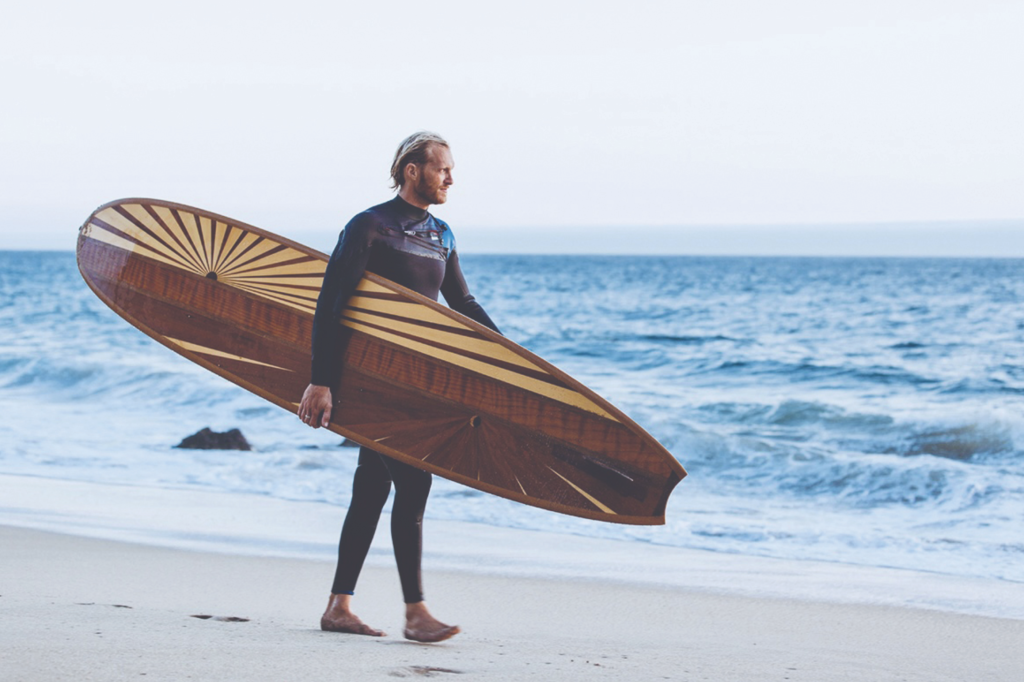
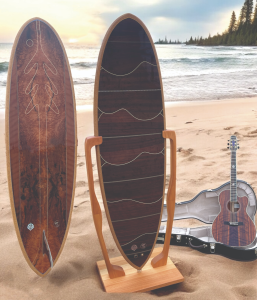
Boaters, surfers, and guitar players are some of the most passionate people on the planet. They’re also some of Lady Nature’s most stalwart stewards. This story is about how a few accomplished and dedicated craftsmen are creating historically groovy surfboards, guitars and boats from remarkable reclaimed and repurposed materials including precious old-growth wood offered up by our primary resource—the sea.
Ventana Surfboards & Supplies: Origin Story
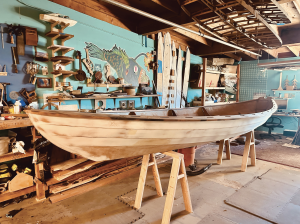
“I was a mate and then a captain on a sailboat in Monterey,” recalls master artisan Martijn Stiphout as we marvel at his meticulously handcrafted fishing skiff made entirely from recycled and reclaimed materials, much of which is wood from the Western Flyer and offcuts from the Santa Cruz Guitar Company. We’re outside in front of Stiphout’s house in Corralitos, California, which is located about 20 minutes inland from the Ventana workshop just south of Santa Cruz.
“I sailed on a Wyliecat 65 for eight years,” Stiphout continued. “We did research and educational programs for the public through the Monterey Bay Aquarium, everything from white shark and jellyfish tagging to trash studies, which was a big eye-opener. I had always used trash as a medium for building things to save on costs. Studying marine biology in school and working with the Aquarium on the Derek Baylis drove home the impact of trash on the ocean. That’s when I started building my first wooden surfboards. I helped my dad build a wooden kayak and a wooden rowboat, and then we took a journey down to the Sea of Cortez in Baja, California. The first time I read Steinbeck’s book I was in a little fishing town. On my 30th birthday I found out that I was laid off from my sailing job. So, I had extra time to think about my future life. When I came home, a college friend said, ‘Dude, let’s start a surfboard company.’”
Their partnership didn’t last, but a few years later David Dennis, a product manager at Microsoft and an avid surfer, came onboard applying his business background and establishing the environmental angle as a core value creating products using recycled materials primarily for ocean lovers and surfers.
“Surfers talk a good environmental game, but most surfboards are made from toxic foam and are basically disposable,” explains Dennis. “We made a commitment to make Ventana Surfboards out of wood, while never cutting down a tree. We realized that using reclaimed wood was the core story, and we could get materials from places with deep wood stories, like the Western Flyer and Santa Cruz Guitars.”
Click to read the rest of this story and see more great photos.