Choosing the Right Trampoline Net for Your Multihull: A Technical Guide
As someone who spends all day working with nets, I’m often brought back to reality by potential customers telling me they know nothing about nets. When nets are what you work on every day, it can be easy to assume that others share the same knowledge, but that’s not the case—and it makes sense! For most people, the day they consider replacing their trampoline nets is the first time they really think about tensioned netting, and it turns out to be a bit more complex than most people imagine.
Tweet
We’ve been making multihull nets for over 37 years and have learned a few things along the way. To keep this entertaining, we’ll touch on key concepts in this article, but if you want to take a deep dive into netting design you may want to take a look at our white paper on netting design.
 Why Your Multihull Has a Net
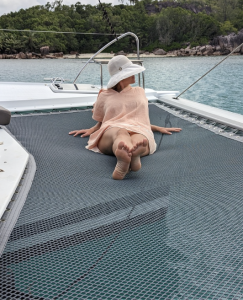
Your multihull has a trampoline net because a nautical engineer determined that the weight savings and low air and water resistance of a net were the best way to improve sailing characteristics and safety while providing usable deck space. The issue is that nets are too often treated as commodities where manufacturers save costs, believing “a net is a net is a net.”
The result? While the OEM net sometimes serves its initial purpose on day one, it often sacrifices safety and durability while failing to offer the living space improvements that a quality net provides. Our interactions with people replacing failing nets show that most lower-quality OEM nets need replacement within 5 years, with many failing as soon as 2½ years after manufacture.
As someone who thinks about nets all day, this feels like having a high-end home where the contractor installed a dirt floor in the living room. As a result, we find people looking to replace their nets fall into two general camps: those upgrading nets on new boats and those replacing failing nets. Whichever camp you fall into, the considerations are the same so let’s get down to the nuts & bolts (or strands & laces?) of tensioned netting.
What You Should Consider
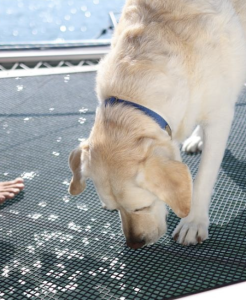
Safety (openness and modes of failure) Durability (how long will the net last, also a safety issue) Stability (how stable is the net and can it maintain tension) Comfort (for owners & their pets) Budget (what are your budget constraints) Aesthetics (appearance and apparent transparency) Service (access to the net engineers) Warranty (manufacturer confidence indicator)All these boil down to Value, which net gives you the best value for your specific wants and needs.Safety: The Foundation Safety has three main elements: Openness, Durability, and Stability.OpennessOpenness measures what percentage of space the net strands occupy versus open area. On catamarans, insufficient openness means high waves coming up through the net can put tremendous force on it, potentially ripping the net or tearing out attachment points. We see this happen every year. Trimarans face similar risks plus possible capsizing if you fly a hull and the wing net catches too much air.