It was the third year of my solo circumnavigation aboard Sailing Yacht Scooter, my 48-foot Amel Maramu Ketch.
Ah, that’s not entirely accurate. There were a few companions in the early days after losing my dazzling wife and sailing partner to cancer fourteen months before departure. Following her mother’s advice, “Life’s short, find a partner, take her sailing; go live the dream you’ve been creating for so many years,” I expected to develop ocean-loving companionship with adventure-seeking landlubbers. Lynn agreed to be flown back to the Hamptons from Charlotte Amalie, St. Thomas, after she recognized that if something happened to me, she would drift around the pond until she was found. Her claim to have sailed to Chaguaramas, Trinidad, proved that her island-hopping time was spent as the chief cook and bottle washer. I hated to give up her gourmet meals, but it was for her safety. Connie came aboard while anchored off Charlotte Amalie to grace Scooter’s decks with her beauty. Thirteen months later, I had to fly her home from Vava’u, Tonga, to relieve her suffering from five weeks of sensory deprivation—blue above and blue below—between the Galapagos and Tahiti, then more of the same on the journey to Tonga.
Looking back, I see my ocean adventure in those early months as mostly solo with a passenger until Tonga, when I truly went solo and remained solo. I then sailed to New Zealand for six months, where an old sailing injury reappeared, forcing me to return to Florida for a knee replacement before my corporate-backed retirement medical insurance unexpectedly expired. I timed the weather windows to sail to New Caledonia, Australia, Christmas Island, Cocos (Keeling) Islands, Mauritius, and South Africa, enjoying what each destination had to offer.
Docked at the False Bay Yacht Club in Simon’s Town, South Africa, provisioned for a 5,600 nautical mile solo voyage up the Atlantic Ocean to Trinidad, a British woman with years of crewing experience worldwide and two Cornell University Marine Biology graduates looking for a ride home after traveling through Africa on an extended break from jobs in Alaska, chatted with me dockside. They responded to an online ad for crew on another boat heading north, but discovered the yacht had issues. In fact, it failed the South African departure inspection. The guys seemed responsible and teachable, and early in our collaboration, the Brit suggested an incentive-based watch plan. I had a real crew for the first time since leaving Tampa Bay early in 2006 after spending a year refitting Scooter with major all-system upgrades for ocean solo sailing.
St. Helena arose from the sea five days after leaving Simon’s Town, where the British crew met a very experienced woman sailing her 53-foot Cherubini ketch solo to Chesapeake Bay. Her husband had flown home from Australia for medical reasons, so the Brit decided to jump ship to assist with her sailing. That left us three men with her share of provisions, including delicious South African wine. After four days exploring the island in search of Bonepart’s history, we started the passage north.
One of the guys mentioned a message in a bottle from his past. Soon, three imaginations bounced ideas off each other. Message bottle launches would be something to look forward to. On the long sail to Trinidad, a diversion from light-air gennaker trimming, idle hours reading, watch standing, and fishing, fishing, and more fishing.
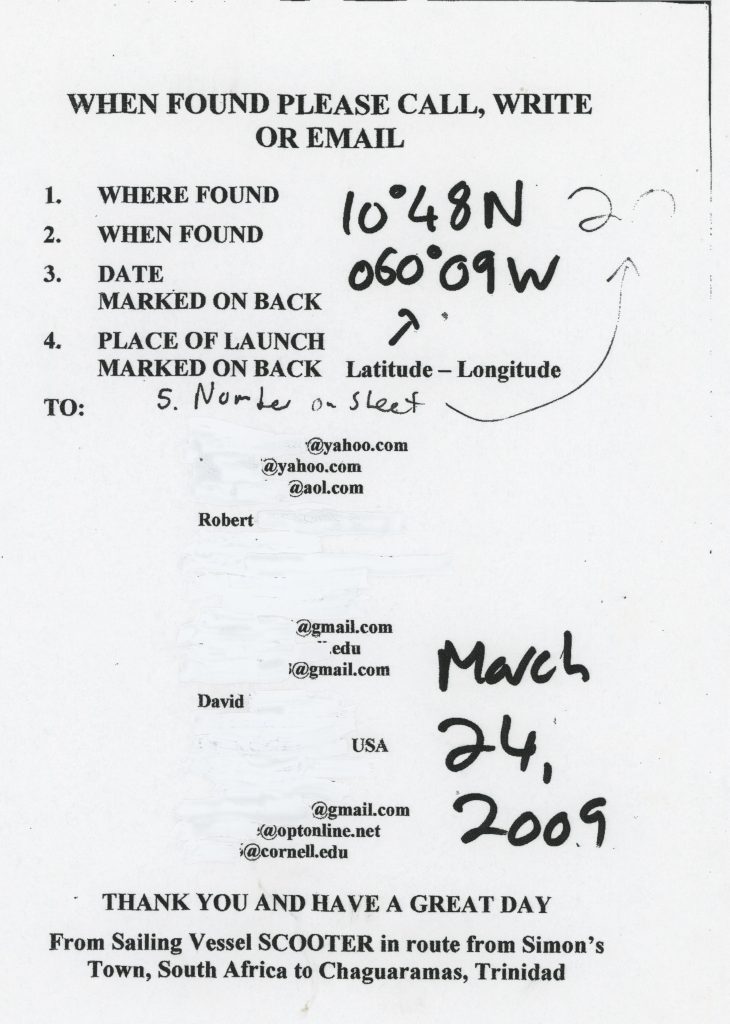
We created the message in Word using simple, easy-to-understand English, including instructions for the finder to record where and when the bottle was found, and how to contact us to report the find. To track each bottle, we developed an Excel spreadsheet titled MESSAGE IN A BOTTLE with columns labeled NUMBER, LATITUDE, LONGITUDE, and DATE/COMMENTS.
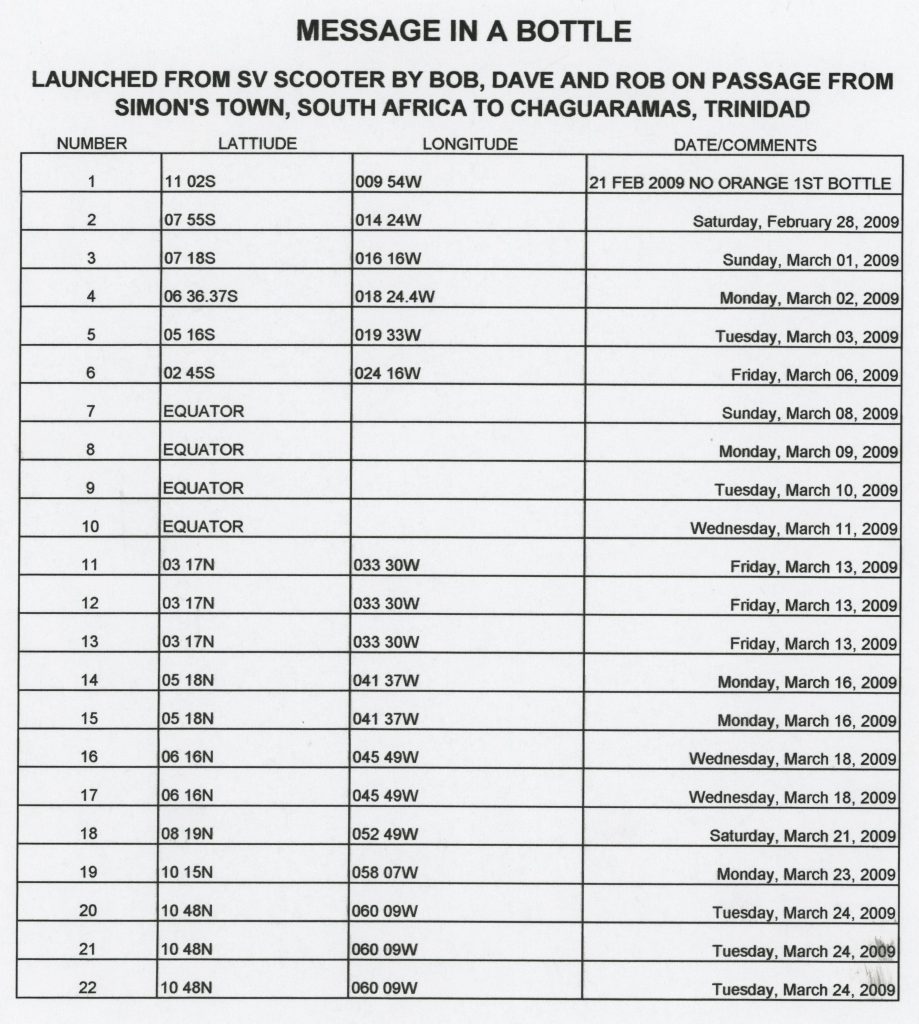
We printed a message for each unopened wine bottle stored below the main saloon decks, red to port and white to starboard. At launch time, we wrote the launch date, latitude, and longitude on the back of the message before it was rolled, placed it in a clean, dry wine bottle, corked, and entered the bottle number, coordinates, and date in the spreadsheet. The first message was delivered at 110 9’S, 0090 54’W between St. Helena and Ascension Island. On February 21, 2009.
After departing Ascension Island, we prepared bottle number two, but at that time, we dripped candle wax around the exposed cork and the upper spout to prevent the cork from eventually leaking. From then on, we sealed all bottles with wax. At 0537 hours on March 8, at 0250 55.208’W longitude, we crossed the equator. Soon after midnight, Scooter slowed to a crawl in light air, conserving the remaining 200 liters of diesel. Message bottles numbered 7, 8, 9, and 10 were launched on March 8th, 9th, 10th, and 11th, respectively, near the Equator.
As the days progressed, Mr. Stink, the Perkins 4-154 diesel, which earned the name, assisted Scooter’s sails. Clouds seen on the horizon ahead were studied for signs of rain below, where there could be wind. As the wind speed and direction oscillated, we sailed, drifted, or motored. Daily fuel checks and weather consults tweaked every decision. Slowly, we crept into the North Atlantic and through the ITCZ (Inter Tropical Convergence Zone – The Brits call it ITC Zed), where warm air heated by the sun flows together from the north and south hemispheres on the ocean surface, bringing great amounts of moisture together. The heated moisture rises to the stratosphere, where it parts and flows north and south to cool, then falls back to earth around 300N and 300S. Looking forward to the rain events, we continued our daily activities and adjusted chronometers again to the time change from Zulu (military for UTC Universal Time Coordinated, which is the modern Greenwich Mean Time), where global time starts at zero hours and minutes. Looking back at the ITCZ clouds to the south while catching good air that was lifting us north, we began to anticipate our arrival in Trinidad.
Bottles 20, 21, and 22 were launched individually on March 24 near 10°48’N, 60°9’W, as we followed our course along the north coast of Trinidad. Overall, we launched twenty-two bottles between February 28 and March 24, 2009.
Months after the Cornell grads flew home from Port of Spain, Scooter was docked in front of a house on a canal in Palm Beach, Florida. I rented an apartment in Lauderdale Lakes, where I could more easily recover from the knee replacement than aboard the Scooter. The journey around the planet at ocean speed had been successfully completed, but the quest to find a life mate had not. It was time to sell the boat, close that three-decade sailing chapter of my life, and focus on dating without having to watch their eyes roll the first time I told them I lived on a boat.
I believed that Scooter should be presented on the market as if it had just left the factory in La Rochelle, France. All surfaces below deck, on deck, and in the machine spaces needed refinishing. If left unaddressed, this might cause a buyer to wonder what else might need repair that isn’t visible. Six months later, when the decks gleamed again, and my new knee was functioning properly, I signed a sales contract, moved Scooter to a private dock on the South Fork of the New River, and waited. My vessel management duties now consisted of keeping her systems ready and the deck clean for showings. Dealing with looky-loos and internet dating for nine months kept my focus. Ocean-sailing memories were safely stored as I pursued new adventures.
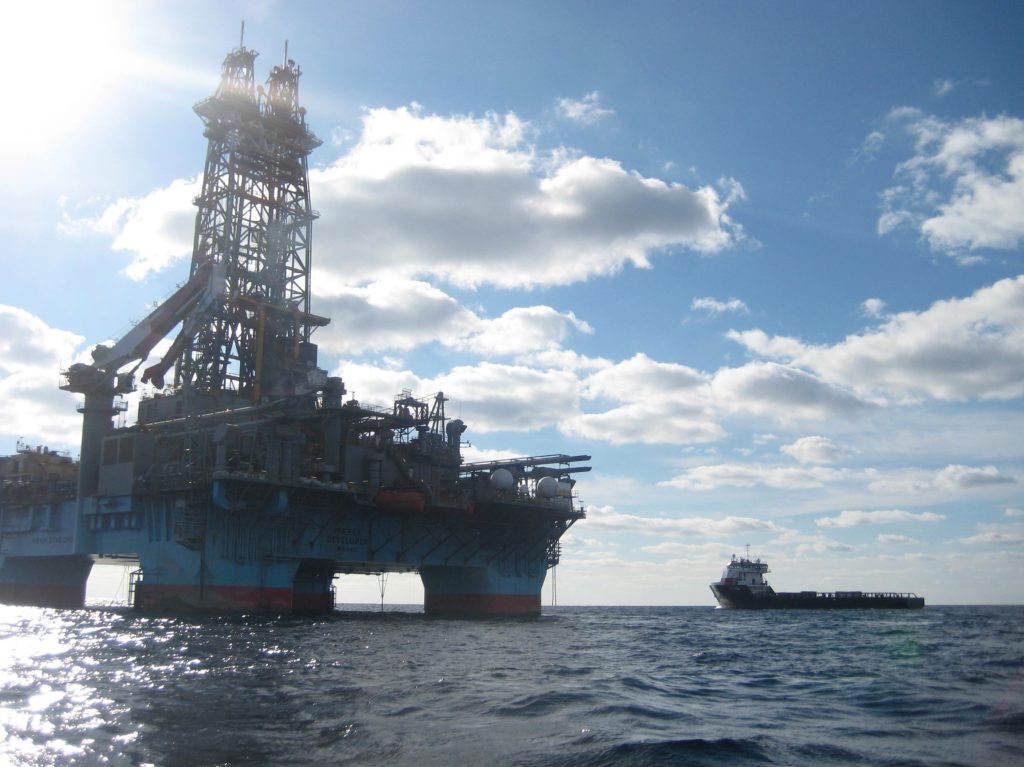
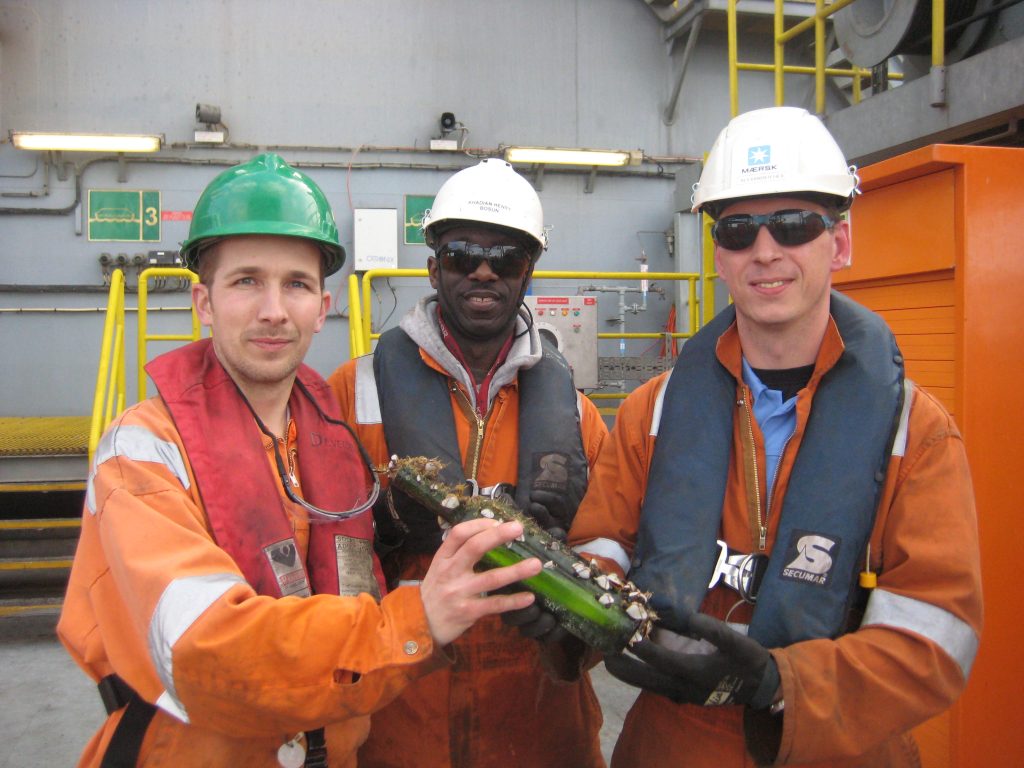
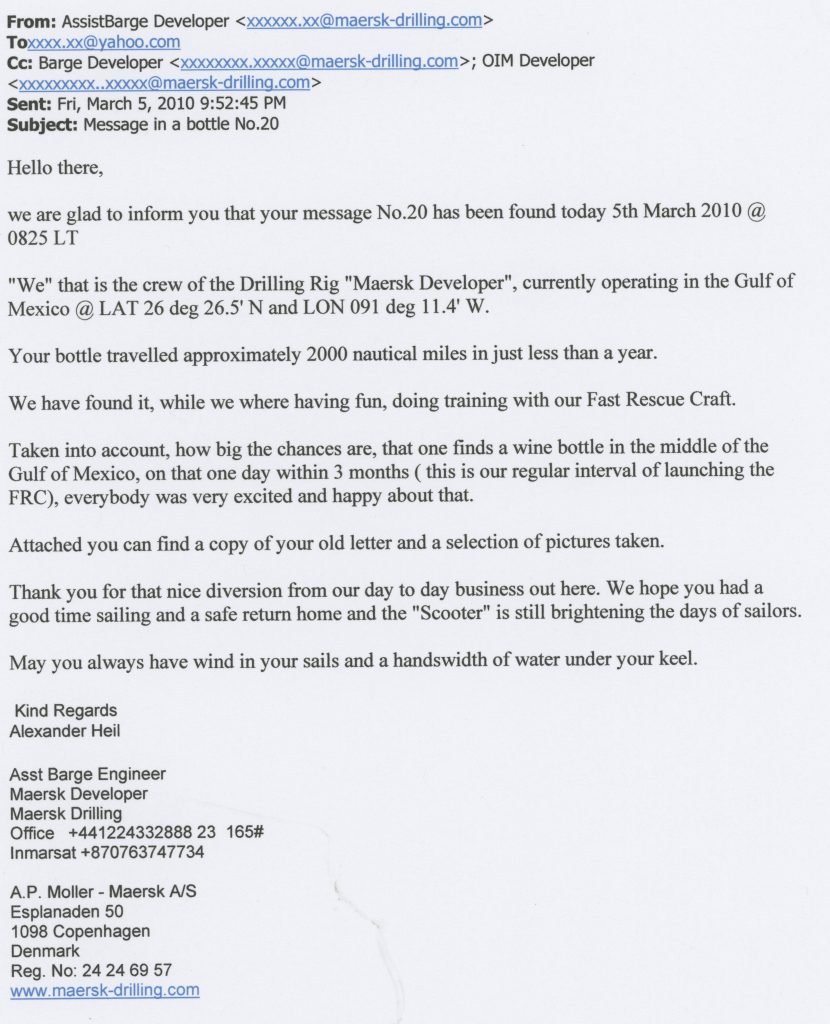
One Saturday morning in March 2010, after checking the weather and news feeds, I reviewed emails and found a surprising message. It was an email from Alexander Heil aboard the Drilling Rig “Maersk Developer” indicating they had found a bottle during a man-overboard training exercise! Bottle number 20, launched at 100 48’N and 0600 09’W on March 24, 2009, had been recovered, turning their otherwise routine day into an unexpected event.
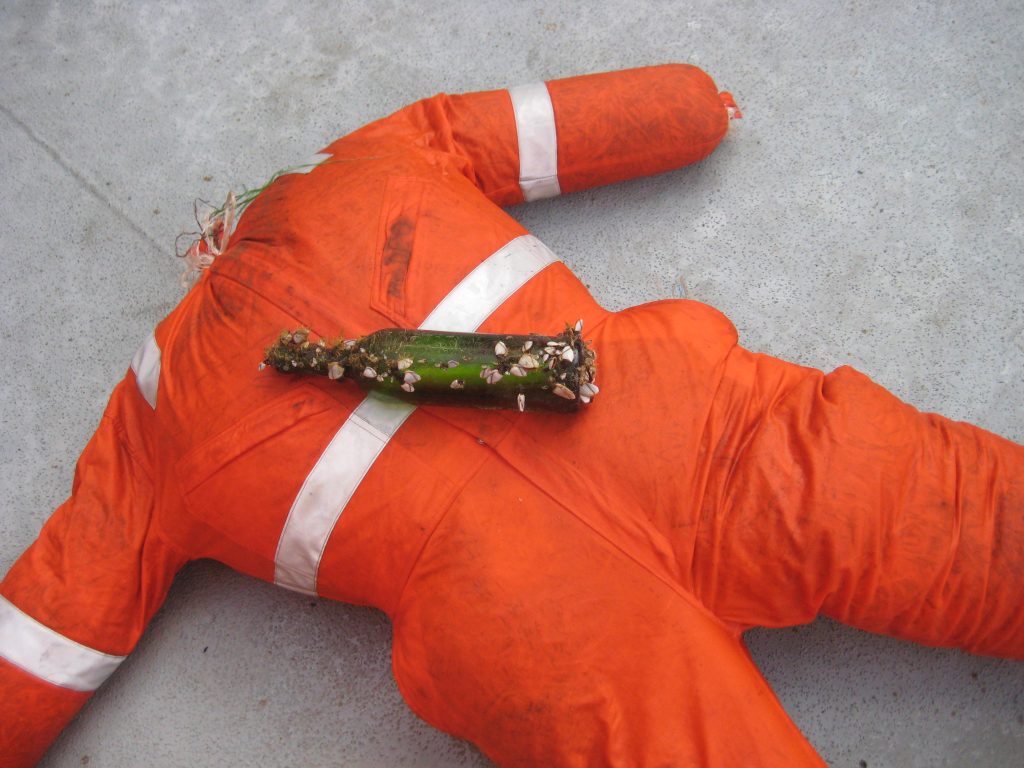
I still wonder what currents carried the bottle from its launch site to the recovery site.
Learn more about Scooter adventures in “OCEAN SPEED: A True-life Journey to Rescue and Revelation” by Captain Bob Krieg, available in print and eBook globally.