Before you can ever hope to catch the wind, you’ve got to learn to speak the boat’s language. Seriously. Knowing your way around a sailboat—from the hull and keel keeping you stable to the rudder that points you where you want to go—is the first real step. It’s what separates a passenger from a sailor.
Getting to Know Your Sailboat
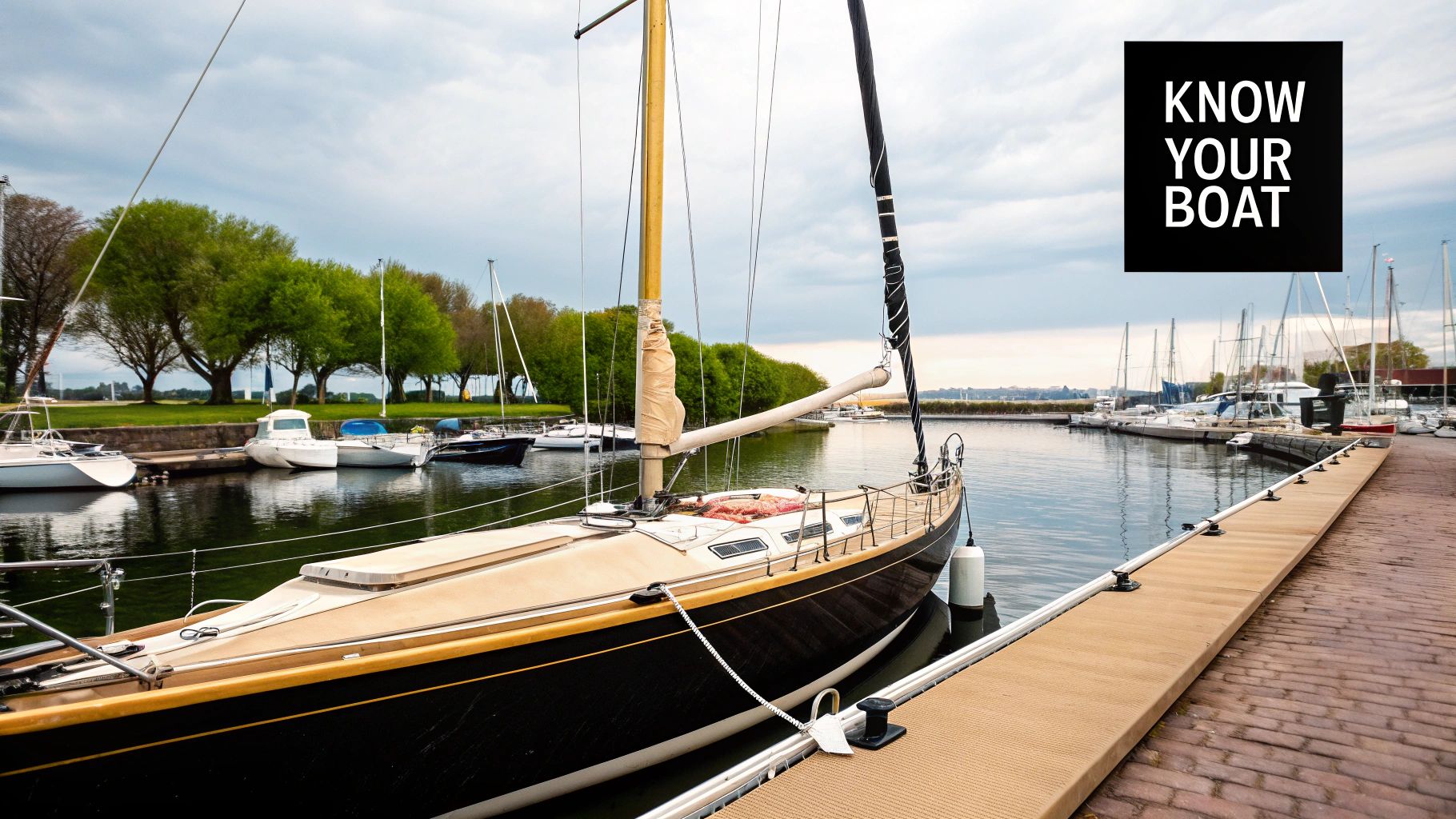
Think of your boat as a complete system where every single piece has a job to do. Learning the parts isn’t just about memorizing a list of new words; it’s about understanding how they all work in concert to harness the power of the wind. This is the absolute foundation, the stuff you need down cold before you even dream of casting off the lines.
And it seems a lot more people are catching on to this timeless way of life. The global sailboat market, valued at USD 6.09 billion, is expected to climb to USD 8.16 billion by 2033. That’s a lot of new sailors discovering the kind of freedom you can only find on the water. A recent report on the sailboat market really digs into the numbers behind this growing passion for sustainable recreation.
The Core Components of Your Vessel
No matter the size or style, every sailboat shares the same basic anatomy. Let’s walk through the big pieces that make up the bones of your boat.
To help you get a quick handle on these new terms, here’s a quick-reference table.
Essential Sailboat Terminology at a Glance
| Term | Function | Why It’s Important |
|---|---|---|
| Hull | The main body of the boat. | Its shape dictates speed, stability, and how the boat moves through the water. |
| Keel | A fin-like structure under the hull. | Provides stability and keeps the boat from sliding sideways. This is your anchor in the water. |
| Rudder | The “steering wheel” at the back (stern). | Controlled by a tiller or wheel, it’s how you direct the boat’s course. |
| Mast | The tall vertical pole supporting the sails. | The backbone of your entire sail plan. No mast, no sailing. |
| Boom | The horizontal pole attached to the mast. | Holds the bottom edge of the mainsail and is a key part of sail control (and something to watch your head around!). |
| Cockpit | The area where the crew sits and works. | This is mission control—it’s where you’ll find the steering and all the lines to control the sails. |
Think of these as the absolute must-knows. They’re the words you’ll hear and use every single time you’re on the water.
There’s an old saying among sailors: “Know your boat, know the sea.” It’s true. Understanding what each part does is your first line of defense out there and the secret to making sailing feel natural.
Understanding the Sails and Rigging
If the hull and keel are the body, the sails are the engine. The rigging—all those ropes and wires—is the complex system you use to control that engine. This is where you and the wind really start to talk to each other.
On most boats you’ll start on, you’ll be dealing with two main sails: the mainsail (the big one behind the mast) and the jib (the smaller one up front). The real art of sailing comes down to “trimming” them, which is just a fancy word for adjusting their angle to the wind to get the most power.
The web of wires holding the mast up is called the standing rigging—you pretty much set it and forget it. The ropes you’re constantly pulling and easing to adjust the sails? That’s your running rigging. Getting a feel for these lines is what makes maneuvering possible. If you want to go deeper on this, our guide on the fundamentals of sailboat rigging is the perfect next step.
Once you have a solid grasp of these parts, every other aspect of learning to sail will start to click into place.
Your Pre-Departure Safety Checklist
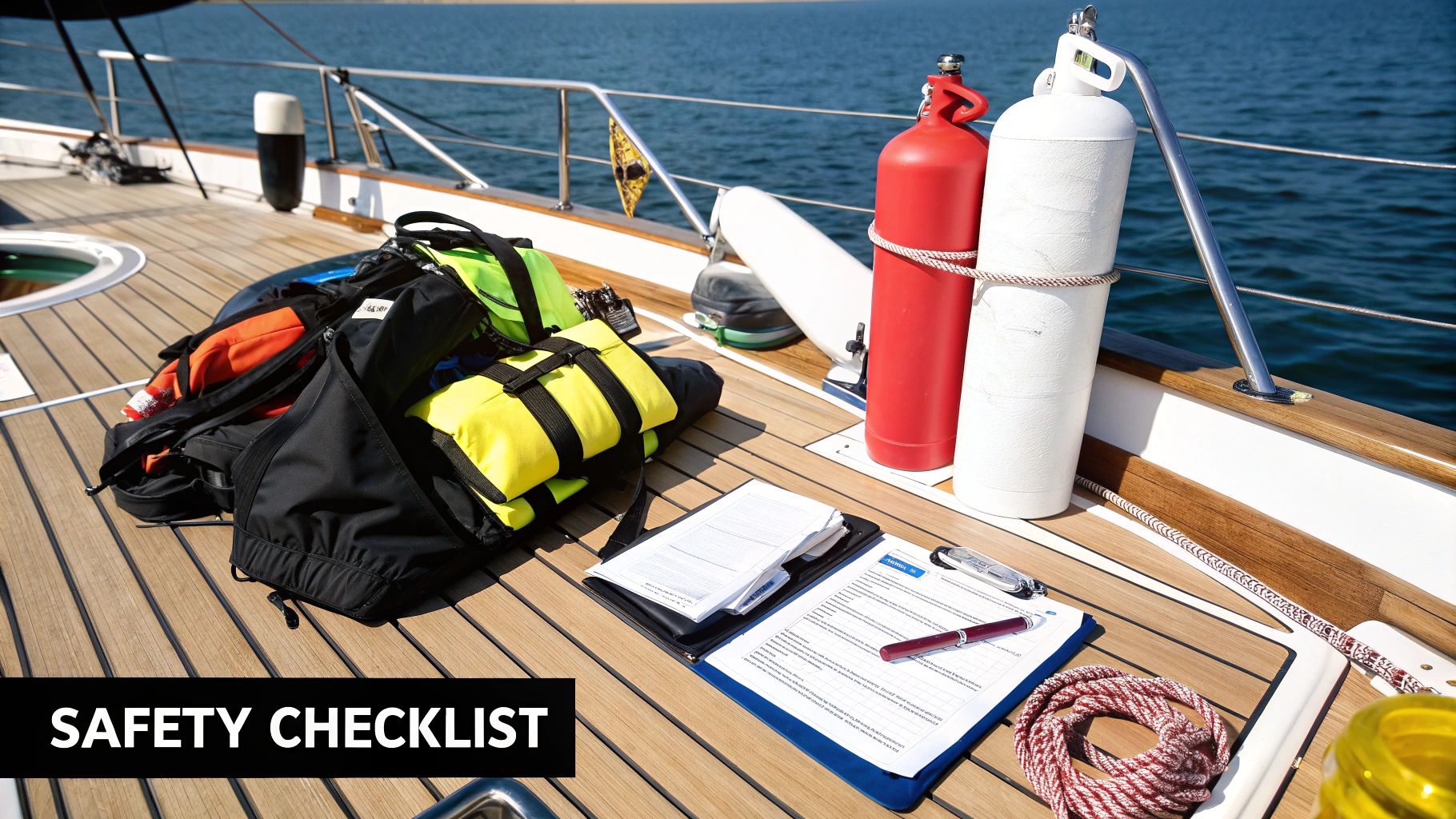
The best days on the water start long before you cast off the lines. It’s all about building a solid pre-departure routine—not just ticking boxes, but really developing the mindset of a responsible skipper. This is the moment you shift from knowing your boat’s parts to making sure they’re ready for whatever the wind and waves throw at you.
This is what separates the seasoned sailors from the novices. It’s the quiet confidence that comes from knowing you’ve done your homework. Think of an ultimate safe boating checklist as your most important piece of gear; it’s a non-negotiable part of every single trip.
Inspecting Your Rigging and Gear
Before you even dream of leaving the dock, take a slow walk around your boat with a critical eye. Start with the rigging. Look for any signs of wear and tear—fraying lines, chafing, anything that looks “off.” Give the pins and shackles a quick check to make sure everything is secure and properly fastened. This simple five-minute walkaround can save you from a massive headache out on the water.
Next, shift your focus to the safety equipment. It’s one thing to have it all on board, but it’s useless if you can’t get to it in a hurry or if it doesn’t work.
- Life Jackets (PFDs): Do you have enough for everyone? More importantly, can you grab them in an instant? Check the straps and buckles for any sun damage or cracks.
- Flares & Signaling Devices: Pull them out and check the expiration dates. Make sure they’re stored somewhere dry and easy to reach.
- First-Aid Kit: Is it still fully stocked from your last trip? Top up any used items and get rid of any expired medications.
- Fire Extinguishers: A quick glance is all it takes. Check that the gauge is in the green and they’re mounted securely.
This isn’t just busywork; it’s a critical habit. If you want to go deeper, we really recommend you read more about what it truly means to talk about safety when you’re on the water.
Checking the Conditions and Filing a Float Plan
The weather is the one force you will never, ever beat. Always, and I mean always, check the forecast from a reliable source right before you head out, even if you checked it last night. Things change fast out there.
A beautiful forecast for light breezes can turn into a small craft advisory in a hurry. Pay close attention to wind speed and direction, any chance of storms, and the tide schedule.
The best sailors don’t fight the weather; they respect it. Making the call to stay in port on a questionable day is the smartest decision you can make. It’s a sign of good seamanship, not weakness.
Finally, tell someone where you’re going. A float plan doesn’t have to be some formal document you file with the Coast Guard. It can be as simple as a text to a friend or family member letting them know four key things:
- Where you’re headed.
- Who’s on board with you.
- A quick description of your boat.
- When you plan to be back.
This one simple step is your lifeline. If you’re overdue, it ensures someone knows to raise the alarm and can give the authorities the vital information they need. It’s an easy, non-negotiable step for every single trip out.
Setting Sail and Reading the Wind
This is it. The moment where all the talk stops and the real learning begins. You’ve gone over the gear, you know the parts of your boat, and now it’s time to hoist the sails and let the wind do the work. The wind is your engine, and learning to read it is the most fundamental skill you’ll ever develop on the water. It’s a full sensory experience—feeling the pressure on the tiller, hearing the satisfying snap of a full sail, and watching the patterns on the water’s surface.
Before you even think about raising a sail, your first job is to figure out where the wind is coming from. Forget the fancy instruments for now. Look at the flags on other boats or on shore. Feel the breeze on your face. Turn your head until you feel it equally on both ears. This simple, intuitive act is the start of a lifelong conversation with the wind.
Understanding the Points of Sail
Here’s the first hard rule of sailing: you can’t sail directly into the wind. There’s a section, about 45 degrees on either side of the wind’s direction, known as the “no-sail zone.” Sailors call this being “in irons.” Try to sail here and your sails will just flap around uselessly, bringing you to a dead stop. Grasping this concept is the key to everything that comes next.
From here on out, sailing is all about positioning your boat at a specific angle to the wind. We call these angles the points of sail, and they determine how fast you go and where you can go.
- Close-Hauled: This is you, pointing as close to the wind as you can get without stalling out in the no-sail zone. Your sails will be pulled in tight, and the boat will probably be heeling (leaning) over. This is your gear for making progress upwind.
- Close Reach: Back off the wind just a bit from close-hauled. You can ease the sails out, and you’ll often feel the boat really come alive with power and speed.
- Beam Reach: The wind is now coming directly across the side (the “beam”) of your boat. For many boats, this is the fastest and most efficient point of sail—a real sweet spot.
- Broad Reach: Now the wind is coming from behind you, over the rear corner of the boat. The sails are let out even further to catch that following breeze. It’s a comfortable, fast way to travel downwind.
- Running: You’re sailing straight downwind. This can be surprisingly tricky for newcomers. The boat can feel a bit unstable and requires a careful hand to avoid an accidental jibe.
Learning to sail is really about mastering the dance between these different points. You’re constantly adjusting your course and your sails to match what the wind is doing and where you want to go.
Finding the Groove with Telltales
Once the sails are up, your next job is to “trim” them so they work as efficiently as possible. The easiest way to do this is by watching your telltales. These are just small pieces of yarn or ribbon taped to both sides of your sail (usually the jib). Think of them as your own personal, real-time feedback system.
This infographic lays out the basic flow of getting underway and using the wind.
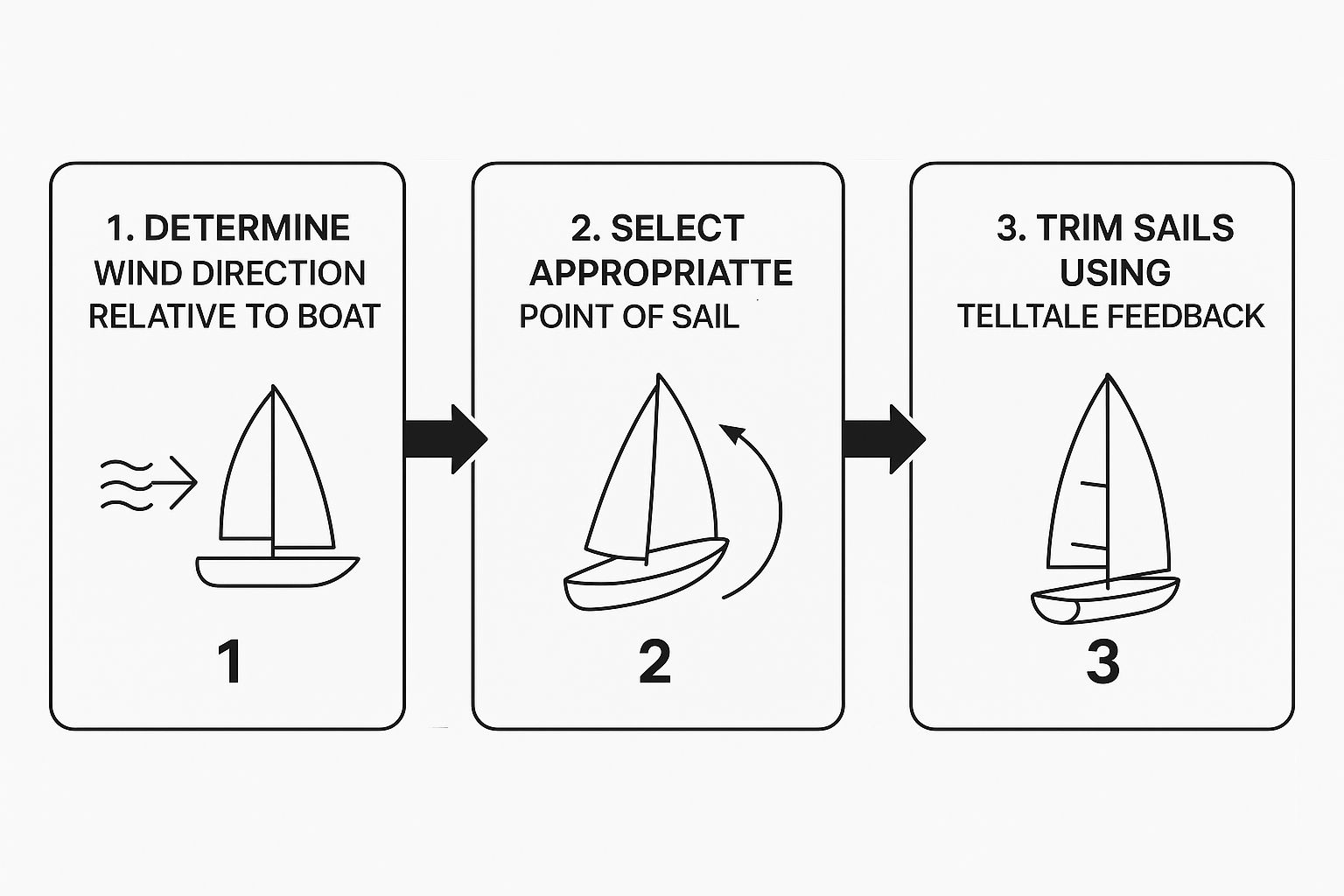
This process—check the wind, pick your angle, trim the sails—quickly becomes second nature.
The goal is to get the telltales on both sides of the sail streaming straight back. When they are, you’ve got smooth airflow, and your sail is perfectly trimmed for your current course.
A sailor’s mantra: “If the inside telltale is fluttering, pull the sheet in. If the outside telltale is fluttering, let the sheet out.” This simple rule will guide 90% of your sail trim adjustments.
Here’s how to think about it: The telltale on the windward side (closer to the wind) will start to flutter and lift if you’re pointing too high or your sail is too loose. The one on the leeward side (away from the wind) will stall and droop if you’re pointing too low or the sail is too tight.
Let’s say you’re sailing close-hauled and the inner telltale starts dancing around. That’s the sail telling you it’s starting to luff. Just gently pull in the sheet (the line controlling the sail) until it smooths out. If the outer one starts to droop, you’ve pulled too hard; ease the sheet out a bit until it’s flying straight again.
Finding this perfect balance is what sailors call finding the “groove.” You’ll feel it—the boat picks up a little speed, the helm feels balanced, and everything just settles in. It’s a deeply satisfying feeling and a huge milestone on your journey to becoming a real sailor.
Mastering Basic Sailing Maneuvers
Sailing in a straight line is fun, but the real soul of sailing is in the turns. This is where you, the skipper, get to dance with the wind, changing direction with purpose and control. The two moves you’ll use constantly are tacking and jibing, and knowing when—and how—to do each one is what separates a passenger from a sailor.
At their core, both are just ways to turn the boat through the wind. The difference is which part of the boat crosses the wind first. A tack turns the bow (the pointy end) through the wind. A jibe turns the stern (the back end) through it. One is your everyday workhorse maneuver; the other demands your full attention and respect.
Executing a Smooth Tack
Tacking is how you get anywhere upwind. Since you can’t sail straight into the “no-sail zone,” you have to zigzag, and each of those zigs and zags is a tack. It’s a controlled, common, and usually gentle maneuver that becomes second nature with practice.
The secret to a flawless tack isn’t speed, it’s communication. Before you even think about turning the tiller, your crew needs to be ready. The classic command is “Ready about!” This is the heads-up for everyone to get set, grab their lines, and make sure the cockpit is clear for the boom’s swing.
Once your crew yells back, “Ready!” you can start the turn. Announce “Helms a-lee!” as you push the tiller away from you. This will steer the bow into and through the eye of the wind.
As the boat turns, a little ballet unfolds:
- The jib will start to luff—that’s the flapping sound it makes when it loses wind. This is the cue to release the old jib sheet.
- As the bow crosses the wind, the boom will glide across the boat to the other side. Always, always be aware of the boom. Even in light wind, it can give you a nasty knock on the head.
- Once the boom is settled on the new side, your crew will pull in the new jib sheet, trimming it for your new course.
A classic rookie mistake is getting stuck “in irons,” where the boat stalls with its nose pointing directly into the wind, losing all momentum. Don’t panic. You can often just push the boom out to one side by hand. This “backs the sail,” using the wind to push the bow one way or the other so you can get moving again.
The rhythm of a good tack is a thing of beauty. It’s a coordinated dance between the skipper and the crew. A quiet boat is often a well-sailed boat, and a smooth tack is nearly silent.
Understanding the Jibe
If tacking is for going upwind, jibing is its downwind counterpart. You’ll jibe when you’re sailing on a broad reach or a run and need to change course. Instead of the bow crossing the wind, the stern does. This means the wind gets behind the mainsail and throws it across the boat, often with a hell of a lot of force.
This is exactly why jibing has a reputation for being the more dangerous maneuver. An uncontrolled “crash jibe” can happen in shifty winds, sending the boom rocketing across the cockpit with enough power to damage the rigging or cause serious injury. Control is everything.
Performing a Controlled Jibe
Like with a tack, it all starts with clear communication. Let everyone know what’s coming with a firm “Prepare to jibe!” This gives the crew a moment to brace themselves and get clear of the boom’s path.
When everyone is ready, here’s how to keep it smooth:
- Trim the Mainsail: Before you turn, pull in the mainsheet hard. You want to bring the boom in as close to the centerline of the boat as possible. This dramatically shortens the distance it has to travel and tames its power.
- Initiate the Turn: Announce “Jibe-ho!” as you gently steer the stern through the wind.
- Control the Boom: The wind will grab the other side of the sail, and the boom will want to fly across. Don’t just let it go. Use the mainsheet to control its speed, letting the line out smoothly once it has crossed over.
- Trim for the New Course: Once you’re on your new heading, you can ease the mainsheet back out and trim your sails for the new point of sail.
Of course, none of this matters if your lines come undone. An indispensable skill for any sailor, foundational to every single maneuver, is Mastering Essential Boat Knots. Every sheet and halyard you handle relies on knowing how to secure it properly. It’s just one of those practical skills that defines a good sailor.
Understanding the Rules of the Water
Knowing how to handle your boat is only half the battle. The second you cast off the lines, you’re not just a sailor; you’re part of a living, breathing community on the water. Figuring out how to interact with other boats safely is every bit as crucial as trimming your sails perfectly. These aren’t just polite suggestions—they’re the maritime “Rules of the Road,” a universal system that keeps order and prevents collisions out on the open water.
Think of it like driving, but without the comfort of stop signs, traffic lights, or painted lanes. Your guide is a shared understanding of right-of-way, colored buoys, and clear communication. This knowledge is what elevates technical skill into true seamanship. It’s the confidence that lets you navigate a busy channel or a crowded anchorage without breaking a sweat, knowing you’re a predictable and courteous part of the whole scene.
Who Has the Right of Way
The heart of the rules boils down to one question: who is the “stand-on” vessel, and who is the “give-way” vessel? The stand-on boat holds its course and speed, while the give-way boat has to make an early and obvious move to stay clear. While there are rules for every conceivable situation, a few key principles cover most of what you’ll encounter between sailboats.
The big one is all about your tack. When two sailboats are approaching on opposite tacks, the boat on the port tack (that’s with the wind coming over its left side, so the boom is on the right) must always give way to the boat on the starboard tack (wind over the right side, boom on the left).
There’s a classic little phrase to drill into your head: “Starboard tack has right of way.” If your boom is sitting on the port (left) side of your boat, you’re the stand-on vessel. It’s probably the most important rule you’ll ever learn.
Now, what if you’re both on the same tack? The rule changes. The boat that is windward (closer to the wind) has to keep clear of the boat that is leeward (downwind). The thinking here is that the upwind boat has “clean air” and more room to maneuver, so the responsibility falls on them to avoid the boat downwind.
Navigating with Buoys and Markers
Out here, the road signs are buoys and markers. These navigational aids are your best friends, guiding you through safe channels, warning you of hidden dangers, and helping you pinpoint your location. In the U.S., the system to remember is “Red, Right, Returning.”
It’s a simple memory trick that works wonders. When you’re heading back into a harbor from the open sea, keep the red, triangular-shaped “nun” buoys to your right. By default, that means the green, can-shaped “can” buoys will be on your left. Following this keeps you right in the middle of the deep, safe channel. Beyond these official markers, you’ll find there are also plenty of unwritten rules of sailing that cover general etiquette in harbors and anchorages.
Sailing is more popular than ever, so you’ll be sharing the water. In the United States alone, the sailboat market stays incredibly active, with roughly 890 active listings on the market at any given time and a median price hanging around $439,000. These aren’t just numbers; they represent a huge community where knowing the rules isn’t just good form—it’s essential for everyone’s safety. You can dive deeper into the data with this U.S. sailboat market report.
Docking and Securing Your Sailboat
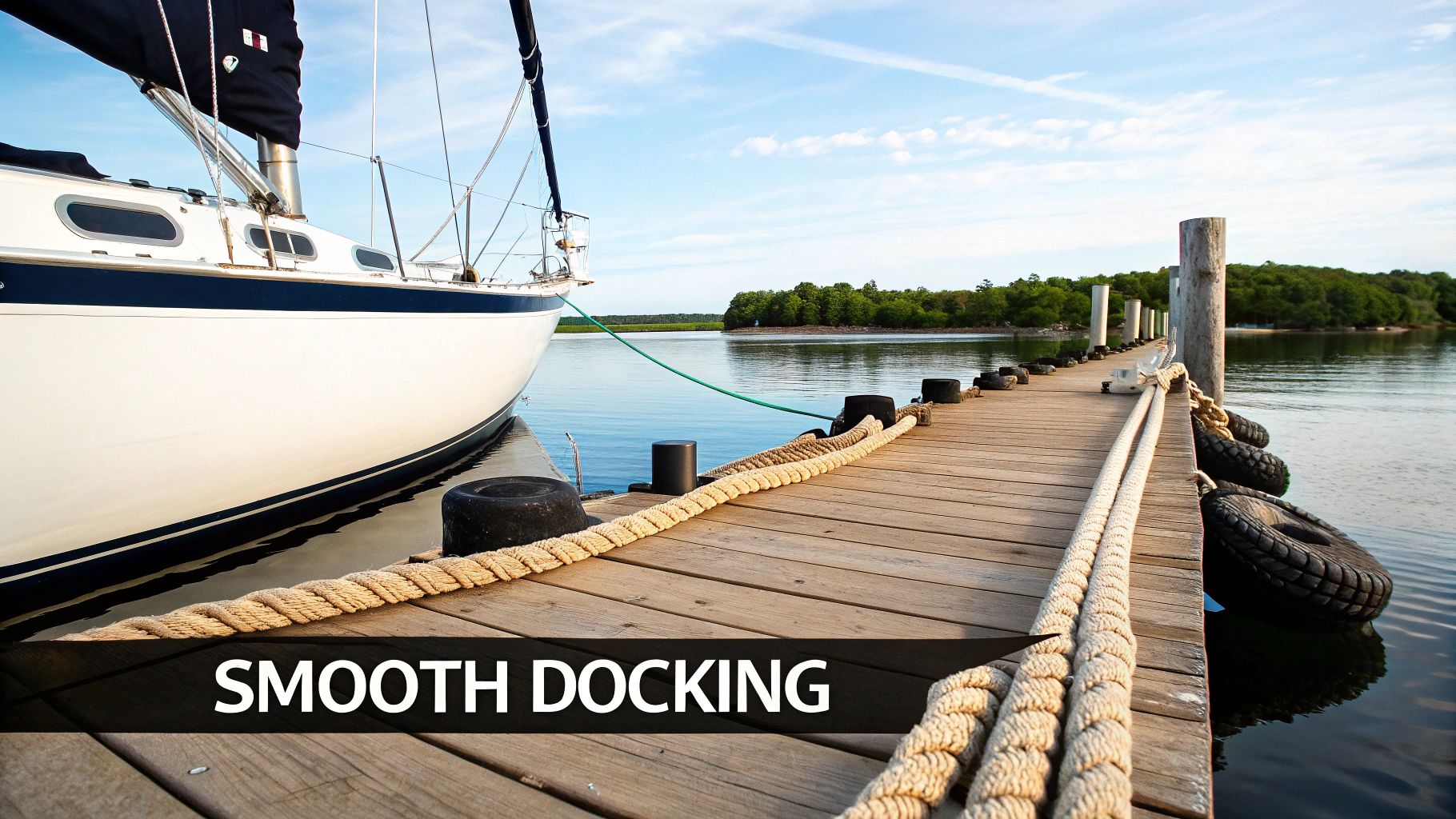
There’s no better way to cap off a great day on the water than with a smooth, controlled docking. It’s a moment that can be either deeply satisfying or incredibly stressful, and the difference often comes down to one thing: preparation. The real secret is learning to work with the two invisible forces that dictate your every move near the shore: wind and current.
Before you’re even within 100 yards of the slip, your approach should be taking shape in your mind. Take a slow pass to read the scene. How is the wind pushing the boats already tied up? Can you spot a current pulling boats parallel to the dock or pushing them away? The goal is to use these forces as your ally, letting them act as a natural brake rather than something you have to fight.
The golden rule is simple: approach the dock into the strongest force, whether that’s the wind or the current. This single decision gives you the most control when it matters most.
Preparing for a Smooth Arrival
A good skipper has the boat ready long before the final turn. Scrambling for lines and fenders at the last second is a surefire recipe for chaos and a banged-up hull. A well-prepped boat, on the other hand, signals a confident and competent crew.
Make this pre-docking checklist second nature:
- Fenders Out: Get at least three fenders on the side you plan to tie up on. Fiddle with the height so they sit right at the widest point of your hull, just above the waterline, ready to cushion any bumps.
- Lines Ready: Your bow and stern lines should be coiled and ready to toss, free of any snags. Make sure they’re run cleanly through their chocks or fairleads. It’s a good idea to have a spring line ready to go, too.
- Crew Briefing: Make sure everyone on board knows the game plan. Assign one person to the bow line and another to the stern. The most important instruction? Don’t jump off the boat. Just loop the line over a cleat; don’t try to muscle the boat in.
Remember the old sailor’s motto for docking: “Never approach a dock faster than you’re willing to hit it.” Slow is smooth, and smooth is fast. Take your time, and don’t ever be afraid to abort, circle around, and try again.
The Final Approach and Secure Tie-Up
With your boat prepped, begin your approach at the slowest possible speed that still gives you steerage. If you’re under power, use short, gentle bursts from the engine and let the boat’s momentum do the heavy lifting. If you’re really showing off and docking under sail, you’ll need to plan your final turn to luff up and stall perfectly alongside the dock—a true mark of skill.
Once you’re alongside, get the lines ashore quickly but calmly. I always try to get the midship spring line on first. This line, running from a cleat near the middle of your boat forward to a cleat on the dock, is your best friend. It instantly stops your forward motion and pins the boat against the fenders, keeping you from drifting forward or back.
With that spring line holding you in place, securing the bow and stern lines becomes a much calmer affair. These lines just keep the ends of the boat from swinging out. Tie them off with a proper cleat hitch—it’s strong, reliable, and, crucially, easy to untie when you’re ready to leave.
Once you’re all tied up, it’s time for the final shutdown. Furl your sails neatly, coil every line and hang it from the rails, and tidy up the cockpit. Leaving your boat clean and secure isn’t just about good seamanship; it’s a sign of respect for your vessel and the final, satisfying step in a day of sailing.
A Few Common Questions From New Sailors
So, what’s the hardest part of learning to sail? I get this question all the time. Honestly, it’s usually not a physical skill, but the mental game—staying calm and making good decisions when the wind kicks up or something unexpected happens. That said, docking, especially with a tricky wind or current, is almost always the one skill that gets everyone’s heart pounding.
Most people want to know how long it takes to feel comfortable. You can absolutely learn the basics in a good weekend course, but getting that real, gut-level confidence? That often takes a full season of getting out there and just doing it.
The single most common mistake I see beginners make is over-steering. New sailors tend to wrestle with the tiller or wheel, making big, jerky movements. Remember, a sailboat likes a gentle hand. Make small, smooth adjustments and give the boat a moment to respond.
Another classic rookie move is underestimating the weather. Don’t just check the forecast the night before. Always, always get an updated forecast right before you cast off the lines. Out on the water, conditions can turn on a dime.
Ready to really dive into the cruising life? Latitudes and Attitudes Magazine is packed with real-world stories, practical tips, and destination guides to help you get out on the water. Start your adventure with us today.
Article created using Outrank