Tales From the Engine Room – Flight Risk
By Owen Murphy
The immense fuselage of Flight Risk sits high up on the hard in the shipyard of Cape Marina. Cabinets, hatches, panels, and furniture are still open or missing as there is still much for the owner to refit. Bits of teak trim and insulation lie about amongst the internal wreckage that is now a mix of old and shiny new. After originally gutting her circulatory system of every locatable wire, the burden of the task ahead admittedly did intimidate and challenge me. But now after a whole lot of sweat, ripped pants, several miles of electrical vessel carefully woven back into her, and installing nearly every form of marine electrical mechanization, I feel comfortable enough to say that she looks rather stunning, at least from my trade-perspective.
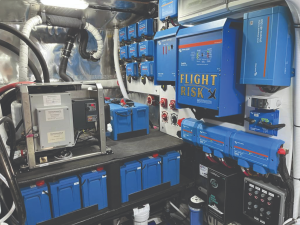
Blinking chargers, humming inverters, brainy modules, controllers, converters, digital panels, analog panels, shunts, finger friendly switches, VHF radios, outlets, plugs, and touch screens galore animate the heart of the vessel. A platoon of lithium ion phosphate batteries, (eight to be exact) are stacked tactically inside to bank the incoming and outgoing electrons. There are so many speakers that one could directly configure sound to every exterior and interior crewman whilst they were napping, working, steering, star gazing, or showering. Two HVAC (Heating Ventilation and Air Conditioning) units and three air handlers for the temperature sensitive mate. Three thaw-proof fridges and freezers, an arctic grade desalination system, an alternator so powerful we removed the ship’s generator, and a European chef-approved convection oven. Accent lighting for that mood, courtesy lighting for guests who might be in a mood, two heads (toilets) that make your household seem boring, and pumps! Oh yes, pumps of all size and shape for engine oils, fuels, fresh water, salt water, bilge water, you name we can pump it! Not a drop of liquid moves throughout Flight Risk without being punched onward by some electron driven diaphragm or impeller engineered by the most corrosion proof synthetics available.
An octet of fore and aft underwater lights are recessed into the hull for an aquatic theater. Eight powered winches sit about the cockpit to assist in torquing lines for some fourteen-hundred square feet of canvas propulsion. Band windlass lie sleeping as titans ready to manage the nine tons of ballast. A freshly welded stern solar arch flexes two 440 Watt panels but with enough space to also fit a large satellite antenna for high speed interstellar travel via wireless internet. One might check the weather or keep up with their social life all while manning the helm through impending channels and perilous seas. I must not forget to mention that all has been linked and interfaced into an elite ethernet network coinciding with NMEA 2000. Mates can turn on any circuit with the touch of their phone or key fob whilst approaching from dock or dinghy all while drinking their martini. There is more but I fear I might lose the reader if I continue exhausting these little equipment descriptions any further.
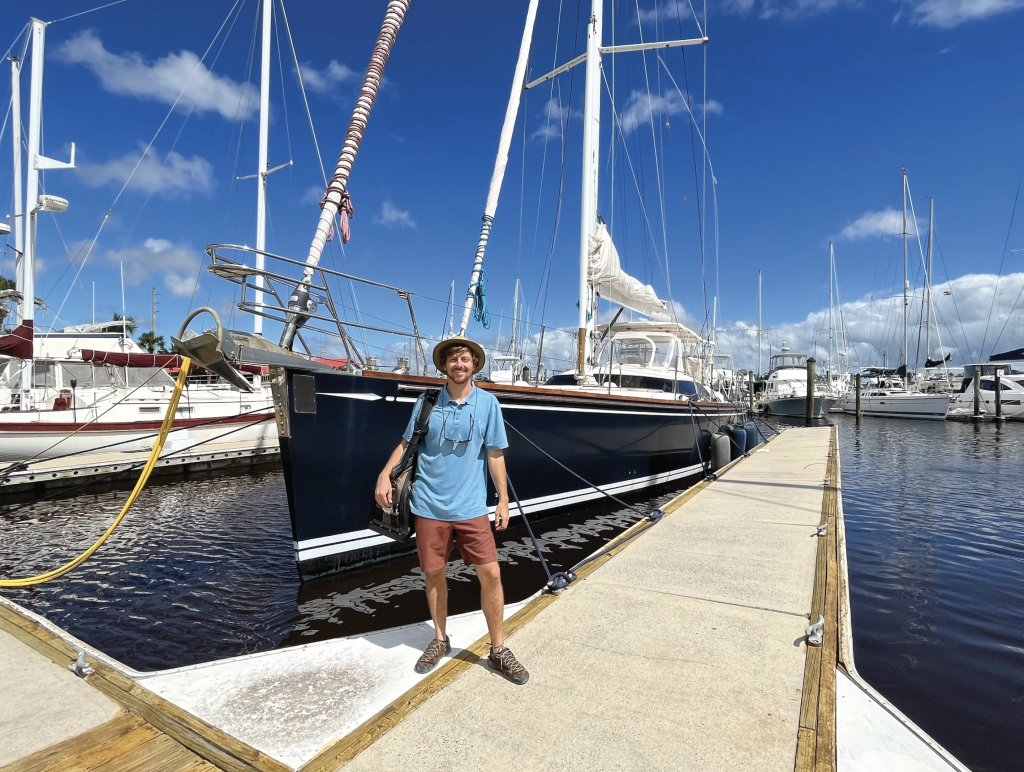
When I first spoke to Huffman, the owner of Flight Risk, it was via phone. I was selling second hand Victron LiFePO4 batteries that I had pulled from another vessel during my time employed with Polaris Marine Electrical in Saint Augustine, Florida. I was also about to depart south on my own ship, Rumi a Crealock 34’ Cutter. I’ve been delicately planning my own circumnavigation since I was thirteen years old and my decamping date was in less than a month. Huffman and I hit it off pretty quickly, discussing ships and marine equipment. It wasn’t long before he convinced me to stop through Port Canaveral on my way south to install a complete Victron system and rewire all fifty-five feet of his 1986 Taiwanese built Tayana. I took off on Rumi in early December.
Huffman invited me aboard his ship the same day I pulled into my slip at Cape Marina. “This used to be a really beautiful boat”, he laughed as we climbed below deck. I was immediately met by the growl of an overworked angle grinder and clouds of fiberglass. The engine room bulkheads and stringers were being disemboweled and rebuilt with carbon fiber by a Slovenian named Rocky, a master of composites who I would soon be working alongside. Huffman showed me about the ship revealing the humongous amount of work ahead of me.
Click to read the rest of this story and see more great photos.